Neil Young in the Barn
photo by Joel Bernstein/courtesy of Gary Strobl
(see PREVIEW TRAILER: Neil Young: Harvest Time)
The Comment of The Moment is from post Film Review: Neil Young's 'Harvest Time' | Variety by Jim:
Went Sunday afternoon to "Harvest Time" in North Carolina and the 92 seat theater was also pretty full. I'd guess about 70 people of various ages.
I thought it was great and was surprised how quickly it went. Was thinking the film was heading to Nashville toward the end but then it didn't go there.
Sat in the front row so I could think about what was going on. When you sit close to the screen your eyes have to interact with what is going on so at movies it is important to sit close. (Words of wisdom from the film master who warned of
entrainment further back in the theater. Robert Altman taught me that trick over breakfast when I was a young lad during a propaganda discussion and his film work for the government on Lookout Mountain in Laural Canyon.)
Did the idea to film start after Johnny Cash show and recording that night with Linda and James?
Guess this HQ recording of the Johnny Cash show appearance linked below could be considered an outtake of the movie but it also when the birth of the "Harvest" sessions, right?
Did the Stray Gators first get together on February 6, 1971?
The Johnny Cash Show aired on February 17th, 1971 but was recorded ten days earlier on the 7th in Nashville according to Sugar Mountain.
In the NYA files it says "Old Man" and "Bad Fog of Loneliness" were recorded on the 6th with James/Linda on both, "Dance, Dance, Dance" recorded on the 7th, "Heart of Gold" was recorded on the 8th again with James/Linda.
Wonder if the band did the basic tracks on the 6th and then vocal overdubs were done by James/Linda on the 8th?
Recording date:
https://sugarmtn.org/sm_show.php?show=197102070
Release date and the Neil Young segment:
https://faroutmagazine.co.uk/neil-young-johnny-cash-show/
Loved all the piano close-ups with Jack and Neil in the movie. Wish they would have interviewed the LSO musicians as they left the session to see what they thought of the song and the rich hippie who played with them.
While watching the movie was thinking I wish they would have done a concert film, like Red Rocks, for the Grey Riders with Hargus "Pig" Robbins. Anyone who saw that tour knows what I'm talking about. Hargus didn't take the emotional level of songs up just a notch, it was several notches, to the point that Neil hasn't released the good stuff yet he did with him. Having seen the Grey Riders three weeks before the first Farm Aid I was ticked that they cut away from the show for "This Old House."
What a great version of the song that got kind of ruined by CSNY. https://www.youtube.com/watch?v=Y3gp-8nYAYk
Whenever I talked with Neil Young one to one he always looked directly unflinchingly into my eyes the whole time while giving thoughtful answers. It was interesting what he said disliking fame in the movie and he could see that weird vibe the way people acted and in their eyes.
[Full disclosure: I was an employee of weekly Variety from 1979 to 1992 ]
My roommate produced an Altman film series and had guests each week.
This was while I was working evenings at a hospital. I'd wake up and in
the kitchen would be director Robert Altman, actor Elliott Gould or
screenwriter/director Joan Tewkesbury in the midst of having a fantastic
breakfast. I'd brush my teeth, grab some coffee and join in bright and
early for me.
Regrettably I didn't put what I
learned from my roommate to work and have a Neil Young Festival. Man,
that would have been fun...I would have had both David Briggs (LA and
Nashville) one week, Joel Bernstein another, Elliott Roberts, maybe Ben
Keith for the musician side, Ron Stone and maybe Elliott Mazer.
Thanks Jim. Yes, a really delightful Neil experience, made even more special by his absence from the stage for over 3 years now. I think were all pretty thrilled to see Neil these days even if its from 50 years ago.
So many highlights for us...
- Neil, Stills & Nash all jamming on separate pianos in the studio
- The jeep ride thru the Redwoods trees
- Neil kissing Carrie delicately
- Elliot telling a poor taste joke
- Drummond's pump pipe scene
- seeing the young L.A. Johnson recording sound
But missed Bruce Berry scene somehow? Anyone recall where BB shows up?
Well, that's entrainment for you!
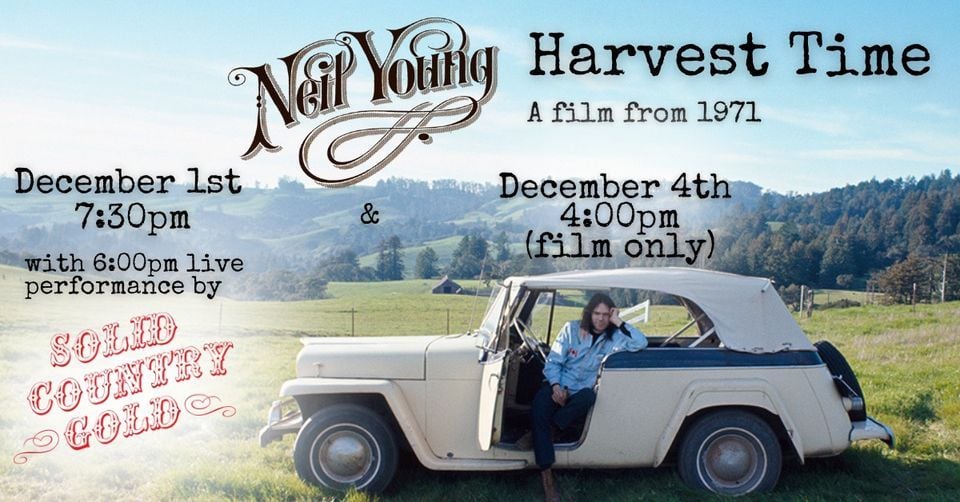
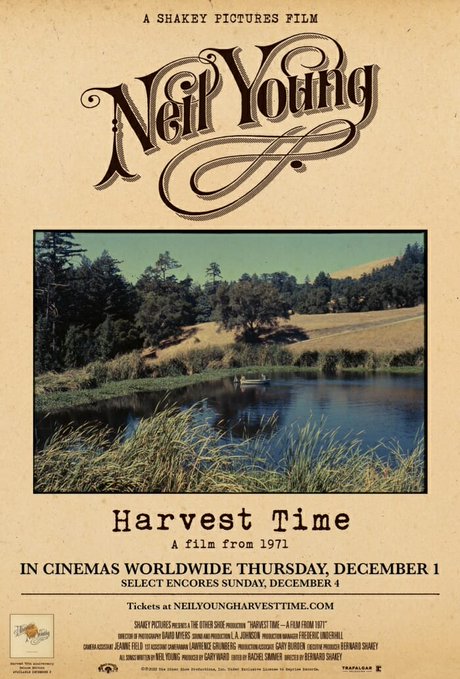
More on PREVIEW TRAILER: Neil Young: Harvest Time.
Neil Young's 'Harvest Time'
(Click photo to enlarge)
Harvest 50th Anniversary Edition Deluxe LP Box SetRelease Date: 12/02/2022
(Click photo to enlarge)
Harvest by Neil Young - Released on February 1, 1972
Labels: album, box set, documentary, film, harvest, neil young, recording, video








 >> Pre-Order on Amazon.com <<





 Human Highway


 Concert Review of the Moment


 This Land is My Land

 FREEDOM In A New Year


 *Thanks Neil!*


![[EFC Blue Ribbon - Free Speech Online]](http://www.thrasherswheat.org/gifs/free-speech.gif)


 The Unbearable Lightness of Being Neil Young
 Pardon My Heart


 "We're The Ones
  Thanks for Supporting Thrasher's Wheat!


 This blog
 (... he didn't kill himself either...)
#AaronDidntKillHimself
(... he didn't kill himself either...)
#AaronDidntKillHimself







 Neil Young's Moon Songs




 Civic Duty Is Not Terrorism
 Orwell (and Grandpa) Was Right


 What's So Funny About



Given the insight added by the Harvest Time quote regarding Alabama, the song can be seen in, if not a brand new light, a more complex one, where it is elevated above its status of Southern Man II. It seems like the self-referential lines begin to incorporate more nods to Southern and country culture as the verses add up.
At first, the subject is primarily Neil himself, dropping minor allusions to keep that country tone going (“the devil fools with…” “swing low,”) as he expresses his personal feelings at the end of March ‘71 [NYA manuscript caption]. “You got the spare change, you got to feel strange” is his ambivalent mood about being a “rich hippie.” “And now the moment is all that it meant” sounds like a critique of a hippieism itself. In the original manuscript, Neil put the word “moment” in quotes, tellingly.
Where Southern Man was a straightforward social commentary and political statement, Alabama is a metacognitive meditation, a critique/questioning of self.
Here the singer sings to himself, playfully naming himself “Alabama.” He recognizes that he is affecting an American style, all the while an outsider. This perspective will be developed in a later line, so let’s look at that chorus first. Rusties will recognize the references to self right out the gate. “…weight on your shoulders that’s breaking your back,” was written between Neil’s major back injury and the resultant surgery. We know he was in physical pain during this time and would hardly stand up with an electric guitar until months later.
“Your Cadillac has got a wheel in the ditch and a wheel on the track.” Know anyone with a fondness for big old cars and ditches? [note: The first Caddy I could find in Special Deluxe was the limo he bought in ‘74 when he and Zeke were on the road with the CSNY tour.]
The next verse names Alabama as the person/subject and, separately, as the place itself (“broken glass windows down in Alabama”) The irony of banjos playing through these broken windows but that also “take you down home” speaks to the personal conflict already established and connects it to the character’s namesake state. The chorus returns, reinforcing the pain and strife of the singer/his subject. The final verse brings back Neil’s discomfort with fame living in the States. “Oh Alabama, can I see you and shake your hand?” is followed by the wry “make friends down in Alabama.” These lines bring to mind Neil’s comment in Harvest Time regarding his new famous life, where people’s eyes don’t look right when they talk to him. [Again sorry for the lack of direct quotes, I’m paraphrasing from memory of the screening last weekend.]
“I’m from a new land, I come to you and see all this ruin, what are you doing?” Another enigmatic line, but following the lyrics above, it seems he is stepping out of the Alabama identity and into the world of Southern Man, having established his own voice as full of contradiction and self-doubt. This seems to add the weight of credibility based in humility to the critical observations first laid out with “see the old folks tied in white ropes.” In fact, that particular line can be read not just as “them Southern folk are KKK,” but that they themselves are tied up, bound by the shameful side of their own heritage, unable to change. The ropes themselves are white, after all.
After asking “what are you doing?” Alabama closes with another question: “You got the rest of the union to help you along/ What’s going wrong?” A mere Southern Man retread would have left this line a reaching throwaway. It doesn’t quite make sense posed directly to the state of Alabama. But given a double meaning whose main purpose is an inward questioning, the line lands hard. We can easily see “the rest of the union” as CSN, Crazy Horse, or even the Stray Gators, from all of whom Neil has begun to isolate himself. He knows they support him, so why is he struggling? It’s worth noting that Neil had expected to be finished with Harvest by April [an offhand remark heard in the movie]. Alabama was written on March 30th, 1971 and no more recording was done until September.
When Alabama was penned, it wasn’t quite Harvest Time yet.