Neil Young in the shadow of a cross From the Journey Through The Past Album
The song "Timberline" -- from Neil Young's unreleased 2001 album "Toast" with Crazy Horse album -- told the story of an unemployed lumberjack and his worldly battles with faith.
"Fooled by the Lord
Fooled by his grace
I put my faith in Jesus
Took away my livin’
Took away my place
Oh Lord"
While Neil Young's views on "faith" are sprinkled throughout his lyrics over the decades, his actual "beliefs" are often some what inscrutable.
The earliest directly overt song on faith by Neil Young was the song "Soldier" from 1972's Journey Through the Past album with the following lyrics:
"Jesus, I saw you
Walkin’ on the river
I don't believe you
You can't deliver
Right away
I wonder why"
Original Soundtracks Recordings by Neil Young - 1972
Since the song "Soldier" -- which was written and recorded in November 1971 -- much, much has happened in Neil Young's life which has caused him to reflect on these weighty matters and compose many additional songs referencing faith and God.
We begin...


In 2005, on NPR's World Cafe, Neil Young was interviewed on the "Prairie Wind" CD.
In the interview with World Cafe's David Dye, Neil revealed some rather personal observations on faith and politics.
And long time readers of Thrasher's Wheat know that we have a particular fondness for the collision of politics and religion.
The question was a lead-in to "Prairie Wind"'s "When God Made Me", a song with lyrics that have provoked a wide range of reaction.
Here's a partial transcript:
YOUNG: "I think
religion and freedom of religion and people’s relationship with God is
something that should not be hijacked by any certain political party.
The Founding Fathers of this country, there were only a couple of them
that were religiously-based or were God-fearing. And now, in the Bush
cabinet, you have almost, like, a hundred percent Christian. I just
think it’s out of balance. I respect their religion, I respect the way
they feel, I respect everything about the way they want to worship, I
respect their right to do whatever they want.
But, I just want to be respected for my right and have my relationship
with God, and I don’t want any political party to be accused of not
being faith-based or to be anti-faith because they don’t happen to agree
with some Christian ethics or some Christian ways of life.
Christianity can be respected just like Muslim religions, like Jewish religion, just like any other religion.
Your
relationship with God is about your relationship with God. When you go
to Heaven, or wherever you go, you... it’s between you and God. It’s not
between, it doesn’t matter, it doesn’t, you know, I could be called a
pagan, I suppose, but if you go back far enough, you’ll find that pagans
really are people who believe in the Earth, they’re people who believe
in the harmony of nature. They’re like the Indians, they’re like the
Great Spirit, they believe in the Great Spirit, and it was the
insecurity of Christianity that turned paganism into a negative term.
And,
if you go back to the roots of these things, and see where they came
from, you know, I respect everyone’s right to do whatever they want to
do, but I think that, this particular administration, and in the country
this time, and it’s only a temporary thing – I have faith in that –
but, ah, I think they’ve just hijacked people’s right for freedom of
religion and, they’ve confused the separation of church and state.
Prayer
meetings in the White House, um, all the time, you know, all of these
things.
There’s nothing wrong with having a prayer meeting, but, and obviously
there’s absolutely nothing wrong with having a prayer meeting, I
wouldn’t, you know, be against that under any circumstances, but it’s a
little bit too focused in one place, and it seems to be that, that, you
know, Christianity has taken a turn here, attendance is down in
churches, there’s a disbelief, it, it’s been hijacked, I feel like
something is totally out of whack, and I think we’re going to get it
back, I think there’s going to be a rebound, it’s a pendulum, and but
the way it’s going right now, there’s just too much of it, you know, I’d
like my kids to grow up free, to live the way they want to live and to
worship their own, worship the way they want to worship without pressure
in the United States of America."

Neil Young's Decade Album Cover - 1977
In a blog post titled "Old Man Take A Look At My Religion", The Mighty Barrister (10/24/05) took a few hard shots at Neil Young's comments on religion in a 2005 interview on NPR's World Cafe.
In
the interview, Neil Young revealed some rather personal observations on
faith and politics. As we noted, some missed Neil Young's point
completely regarding the separation of church
and state.
On the contrary, "Prairie Wind"'s song "When God Made Me" is
not "a subtle attack on
Christianity".
A very close analysis of the lyrics reveals nothing of the sort. There's been quite a bit of debate about the lyrics and here's what commenter Togu posted about "When God Made Me" lyrics:
"This is an incredible song because of what Neil achieves with the lyrics and music combined.
It
is a warm melody and rendition, so you can't say that Neil is out to
argue. The song is disarming because of its plaintive melody and
questioning. It makes you ask: can God who is so great and so gracious
really be as limiting as we humans often make him out to be?
The song also celebrates the incredible diversity of persons that God
created and the wonderful gifts God gave to each person and asks what
those gifts are meant to be used for. It also asks why don't we cherish
these gifts in the way they were meant to be used?
I'm a Christian myself and I'm sorry to see how some feel the need to
peg this as a Christian or non-Christian song.
Listen to the music first and let its honest questions move you."
Blogger
Dave Faulkner
offers a healthy and even handed comment from the Christian community
on the song "When God Made Me". His comments come in the context of
similar comments that Neil made in an interview in Word Magazine:
"Rather than dismiss Young due to those apparently strange views, it would be better to look seriously at what he says.
Of
course as a Christian I don't believe that the doctrine of God making
humankind in his image is about conceit or arrogance: it's an act of
pure grace and it should not make us careless with the rest of creation.
But the problem is, that is precisely the way it has been taken for
centuries and we now have an environmental problem.
We need to
hold this together with Young's statement that 'We're all here together,
we're all nature', except that I would just change that last word from
'nature' to 'creation'."

"Did God give me my voice so that others could silence me?"
Neil Young sings "When God Made Me"
Live 8 Benefit Concert - July 2005
It strikes us that the lyrics of Neil Young's "When God Made Me" from 2005's album
Prairie Wind still continue to be poignantly prescient.
Did he give me the gift of voice
so some could silence me?
Did he give me the gift of vision
not knowing what I might see?
Did he give me the gift of compassion
to help my fellow man?
When God made me.
(Complete lyrics and analysis for
"When God Made Me".)
And just as
Young's performing of John Lennon's "Imagine" for the 9/11 "Tribute" and the song's debut at the
Live 8 Benefit Concert in July 2005, the performance has incited passions.
The reaction to the song's
lyrics for "When God Made Me" generated more reader comments than just about any other article on Thrasher's Wheat history at the time.
For example, from
Peter V.:
"A beautiful song, lyrics and melody, which embodies the
heartfelt surge that is mounting in America's conscience to challenge
the overbearing sentiments of the religious right that have been choking
the compassion of this country. This song fills my heart with hope that
once again we will know that the power of God is love."
And Goodlife said:
"Hearing "When God Made Me" caused me to flip on the
computer and "google" looking for the lyrics. I am a believer ... but
not a part of the fundamentalist right. This is a song which touches my
inner spirit. I hope many will hear its message, and think deeply about
who they are underneath the encumberances of their everyday life."
Of course not everyone was pleased when rock stars venture into the debate on religion. Tim Graham posts on
NewsBusters:
"Are rock stars trying to give us lectures as they sing on
hurricane-relief benefits? Last night's mega-channel concert featured
Neil Young sang his song "When God Made Me." The lyrics clearly show
Young thinks that the problem with religion is that God tends to favor
people who believe he exists. That, and religion is the reason for too
many bloody wars. Some compare it to John Lennon's "Imagine," but Lennon
wants no God, and Young just thinks He might be a Unitarian
Universalist."
Here's an interview with Neil Young from the TW Archives (via Esquire circa 2006) on "What I've Learned" by Cal Fussman:
What about God have you learned?
Neil Young: When I was six, I really didn't know what God was. But I did know about
Sunday school. I was reading a lot about God, but I was bored. I
couldn't wait to get out of Sunday school. God was secondary to the
whole thing. But as time went by, I got more and more angry, to the
point where I didn't like religion. Hate is a strong word. But I just
kept getting angrier and angrier...until finally I wasn't angry anymore.
I was just peaceful, because I thought: This is not fruitful for me. I
rejected the whole thing and found peace in paganism. Jesus didn't go to
church. I went way back before Jesus. Back to the forest, to the wheat
fields, to the river, to the ocean. I go where the wind is. That's my
church.

Where Do We Go Now ...
or Where Did We Go From There? Charles Theater, Baltimore, MD
December 2012
(Note: Photo not Photoshopped) From the November issue of Word Magazine, interviewer Robert Sandall asks Neil Young whether he is a Christian?
YOUNG:
"I don't know. I don't think so. I certainly don't say, don't be a
Christian. Everybody needs something to hang their hat on. But I really
don't buy into any particular story. The Indians had something going on
with their 'great spirit' as a term for God. They were more concerned
with the trees, the grasslands, the animals and a sense of balance. It's
a pagan thing and there's nothing bad about paganism. It only became
bad because of the insecurity of the church. That song is about the
self-righteousness that makes certain people think God created man in
his own image. What a conceited idea! What about the squirrel? What
happened to him? We're all here together, we're all nature. One big
thing."

Neil Young - 2005
Photo by Chris Pizzello
From "
Companion" interview with Neil Young by JODY DENBERG in OCTOBER 2005:
JODY DENBERG: Neil, thank you so much for joining us for this Prairie Wind Companion. Prairie Wind
seems a definitive snapshot of where you're at today as you approach 60
and it's a beautiful piece. But in the hundreds of songs you've written
it's been rare that you've sung directly about God. What were the
circumstances of you composing Prairie Wind's final song, When God Made
Me?
NEIL YOUNG: First of all I didn't know what I was doing. There was a
little room with a piano in it. And the piano is locked in the room.
It'll never leave the room unless they destroy the room. It can't leave,
'cause the room was built around it. And the room is in a church. The
studio is in a church. So the ceiling of this studio has got a few
little vents in it. And if you stand on top of a ladder with a
flashlight and look up through the holes, you can see the, the church
windows.
And this old huge roof and everything, and it's closed off, because to
get the right sound and everything they, they made a lower roof. But
when you see that, it really gets you. And then I just started playing
this hymn. And, and, you know, a Spooner Oldham is one of the most
beautiful, uh, beautiful Gospel, you know, on the organ, it's just
great. I mean he's just alive with it.
So, you know, I've learned a lot from him over the years, just listening
to him. So all the passing chords and the blending of things together,
the, but all hymns seem to have these little passages on the piano
between them that sets up the next verse, kind of gets everybody in the
key and kicks it around and gets ready to go. It's, so I found myself
just playing this, and I had absolutely no idea what I was doing. Still
don't.
One of the things that, that bothers me today is how religion seems to
have been hijacked and politicized by the administration. The thing that
bothers me the most is how one political party can say that the other
political party is not faith-based. That, how can you say something like
that? And I think it doesn't represent America. It only represents part
of America. And I think that faith has a lot to do with family and
loving God.
It doesn't matter whether you read the Koran or whether you're a
Buddhist or whether you're, whatever you are, you're still trying to get
in touch with the one thing that made us all, who we are, the great
spirit. So I feel like that's been taken away from us. It's being used
as a tool against some people. And, uh, and so that bothers me a lot. I
don't like to go into church and hear the Star Spangled Banner.
That's a song about bombs bursting in air. Let's, let's have God Bless
America if we're going to sing a song like that. I don't think that one
is really needed either. But if you're going to have one, let's, let's
have one that, that, that tries not to think about our country only.
Let's start, let's have a song that tries to think about humanity and,
you know.
So, you know, one of my friends went to church last week here in and,
and had to stand there while we sang about, you know, bombs bursting in
the air and that was the first thing. I don't believe that. I don't,
and, and I think a lot of Americans and Canadians and just citizens of
the planet don't necessarily go along with that. And that's why there's
such an upheaval in the church and that, you know, attendance is off?
Some places it's up. But a lot of places it's not up. It's down. And
it's because the church has been, you know, taken to all these different
places. And really, it should be everywhere. It shouldn't be a tool.
JODY DENBERG: Neil Young asking the big questions on When God Made Me,
the final song on his new album. The answers my friend are blowing in
the Prairie Wind. Neil's new album that brings together his dreams, his
love of family and friends, and his concern for the ecology in a way
he's never done before.


Prairie Wind Companion CD
Here are the lyrics for the Neil Young song "When God Made Me" from
Sharry (Up in T.O. keepin' jive alive) posted on Rust:
WHEN GOD MADE ME
Was he thinking about my country,
or the colour of my skin?
Was he thinking about my religion,
and the way I worshipped him?
Did he create just me in his image,
or every living thing?
When God made me.
When God made me.
Was he planning only for believers,
or for those who just had faith?
Did he envision all wars
that were fought in his name?
Did he say there was only one way
to be close to him?
When God made me.
When God made me.
Did he give me the gift of love
to say who I could choose?
When God made me.
When God made me.
When God made me.
Did he give me the gift of voice
so some could silence me?
Did he give me the gift of vision
not knowing what I might see?
Did he give me the gift of compassion
to help my fellow man?
When God made me.
When God made me.
When God made me.
The lyrics are ripe for interpretation. And everybody likes to
analyze Neil's song meanings.
At first glance, certainly not Neil's most obtuse lyrics like "
"And I saw you in my nightmares, but I'll see you in my dreams" but more like the enigmatic lyrics "
What is the color when black is burned?".
On second glance there is a lot going on here. Start with the gospel choir-like
Fisk University Jubilee Singers.
The student vocalists introduced "slave songs" to the world and, in
many opinions, preserved this music from extinction. So Neil has not
embarked on some light-hearted exercise here as many seem to believe.
The debate and controversy over the "When God Made Me" lyrics continues to this day.
, things settled down.
, the debate heated up once again. A comment by Matt M. sums things up as well as any of the many provocative interpretations:
Read for your self how a man asking 10 simple questions ignited a firestorm.
An interesting exercise to answer Neil's questions laid out starkly in the deceptively simple lyrics.
Others question Neil's motives. For example, on
,
Douglas LeBlanc writes rather absurdly and demonstrates a complete lack
of lyrical analysis -- much less christian-like empathy:
Not until Young realized that the recording studio was actually in a former church, was he able to complete the song.


 Neil Young in "Mansion On The Hill" video


 >> Pre-Order on Amazon.com <<





 Human Highway


 Concert Review of the Moment


 This Land is My Land

 FREEDOM In A New Year


 *Thanks Neil!*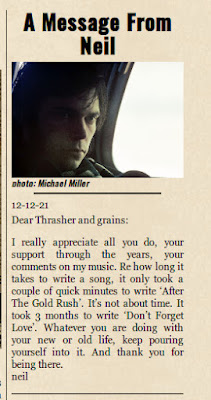


![[EFC Blue Ribbon - Free Speech Online]](http://www.thrasherswheat.org/gifs/free-speech.gif)


 The Unbearable Lightness of Being Neil Young
 Pardon My Heart


 "We're The Ones
  Thanks for Supporting Thrasher's Wheat!


 This blog
 (... he didn't kill himself either...)
#AaronDidntKillHimself
(... he didn't kill himself either...)
#AaronDidntKillHimself






 Neil Young's Moon Songs




 Civic Duty Is Not Terrorism
 Orwell (and Grandpa) Was Right


 What's So Funny About