Neil Young's new release ""World Record" w/ Crazy Horse is now available for pre-order. Order here (Please shop locally & independently. But if you can't, we appreciate your supporting Thrasher's Wheat by clicking this link
or YOUR COUNTRY's FLAG. Thank you!!!) ADVERTISEMENT
An unofficial news blog for Neil Young fans from Thrasher's Wheat with concert and album updates, reviews, analysis, and other Rock & Roll ramblings. Separating the wheat from the chaff since 1996.
Dreams for Young are sometimes a puzzle to solve and at
other times a new geography to explore, corresponding to the two
dominant dream theories of the 1960s: the Freudian theory in which
dreams are a working through of repressed psychic matter; and the
existential humanist view of dreams as an alternative topography.
Dreaming is rarely a doorway to the state of lost innocence for which
Young yearns in “Sugar Mountain,” but it has the capacity to transport
the singer and the listener elsewhere. Through the act of dreaming Young
can drift purposefully, pulling together sounds, images and colours in
creative ways, and can explore the twists and turns of the unconscious
where one image blurs with the next. The nature of dreams means that
their shape keeps morphing. This can lead the dreamer towards deeper
meaning, but can also drift away into impressions and noise. At times
Young searches for direction–such as the quest on his 2007 track “Spirit
Road” to discover the “long highway” within — and at other times
escapes from meaning into a play of imagery and sound.
We can identify this second trend in one of Young’s early dream songs,
“Broken Arrow.” This six-minute coda to the second Buffalo Springfield
album Buffalo Springfield Again seems to be inspired by the early-summer
release of The Beatles’ concept album Sgt. Pepper’s Lonely Hearts Club
Band, leading Young to incorporate crowd noises from a Beatles concert
and the opening distorted snippet of a live performance of “Mr Soul,”
sung by drummer Dewey Martin. Despite its musical variety there is
little input from the band, except for backing vocals by Richie Furay,
added after Young had recorded the song in September 1967. Its power
stems from Young’s sound experiments and the visually arresting figure
of a Native American standing alone on a riverbank with an empty quiver.
This image of the ‘vanishing Indian’ with a broken arrow suggests
either surrender to an unstoppable force or an offering of peace.
What
makes this a mysterious image is that there is no discernible enemy in
sight; instead the verses describe a triad of social pressures (fame,
adolescence and marriage) as if modern social organization has defeated
the nobility of the Native American.
"All in a dream, all in a dream
The loading had begun
Flying mother nature's silver seed
To a new home in the sun
Flying mother nature's silver seed
To a new home"
Comment of the Moment: Jonathan Demme Double Feature Weekend: Neil Young's Complex Sessions + Trunk Show
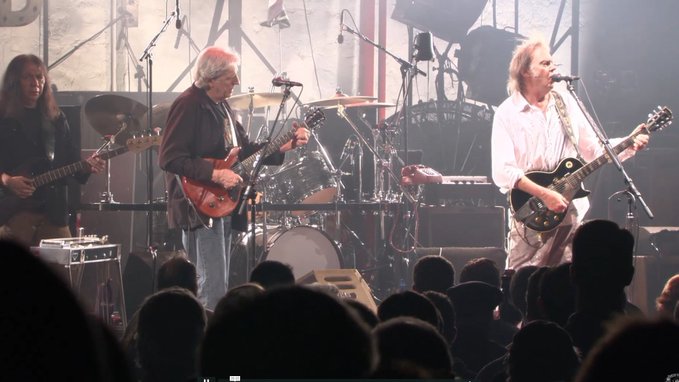
Neil Young and His Band
via Jonathan Demme's Concert Film Trunk Show
This past weekend on Screen #2 in Hearse Theater of Neil Young Archives, a Jonathan Demme Double Feature was streamed of the films Complex Sessions (1994) and Trunk Show (2009).
Jonathan Demme's concert film Trunk Show from the 2007 tour has been long sought for years for a proper re-release and folks were not disappointed judging by some of the rapturous comments. But before getting to the Comment of the Moment, a couple of runnerup CotMs to mention.
No Hidden Path (with extended fizzling guitar solos that sound like fissures erupting in the Earth) is a highlight of both shows, but whatever it sacrifices in pure unbridled energy at the penultimate London show is made up for in musical sharpness and focused intensity - the sense that the guitar solos have their own story to tell and journey to take us on. Thankfully we now have had the chance to enjoy both films, on their own merits. But for me, Tim Pope's London is the most captivating of the two films.
Definitely an interesting an analysis of the two filmmakers and their approach to capturing Neil Young in concert, so be sure to check out Scotsman's full comment.
I agree with Scotsman that London creates a more compelling concert experience. Yet Trunk Show manages to create a slightly more intimate experience, although in a truncated fashion. I actually loved both films equally but for different reasons, and extremely happy that Neil plans to release both films commercially.
Who Is Watching
"We are not souls dwelling in a body. We are bodies dwelling in the soul." --Tiokasin Ghosthorse
When my grandsons are older, I can watch Trunk Show with them.
I can tell them how we saw the show in Boston just a few days before this was filmed, when Pegi opened for Neil and then sang with the band. When Ben and Rick rocked like kids in the garage and No Hidden Path was even longer and more glorious than this one, or maybe it was just me and their uncle being there to see it and hear it and be there.
I can tell them how the man who directed this film was a charming and creative person, how he came to Boston to show the film he made and talk to everyone there about it, tell them about being there when he talked about his decision to put more cameras there and that he was one of the people filming the show. About how he illustrated his method by having his friend Robyn Hitchcock perform a song and asking anyone with a camera--back then it was not that common and often forbidden to have one at a concert--to film Robyn's performance and send the video to him, he'd try to include it with his own film of the performance using lots of his own cameras to get a feeling of how people experience live music.
I can tell them this was a different way to film music, before live streams and DIY shows and whatever else has happened since then. That they were doing something a little bit different that maybe caught on and gave us a chance to see how it was. That every film is really a bit of time travel but mostly it's what you're seeing right now and how that can be a part of the present and the past. That I sat one morning thinking of them and our family while trying to find words to describe how it felt to be there.
I can tell them how wonderful and also sad the songs about Carrie seemed then and even more so now. How watching Neil with Pegi and Ben and Rick can make you happy even when you're thinking that they're gone. How knowing that Jonathan and Elliot were such a big part of this and they're gone was part of my reason for appreciating this now while I'm thinking of them and what we might do later. How Neil had this film that lots of people wanted to see because the music is great and the performers were amazing and he decided to show it at just the right time.
Sometime later I can tell them how it was dedicated to a friend who was part of so many wonderful films, how he was a great buddy to Ben and his family. I can tell them about the people who are gone and are still here when we watch and think and talk about them. How music is like love and life is our song. Then we'll watch and listen and be there again.
Thanks Mr Henry, Scotsman, Dan and all for sharing your thoughts and comments!
And what did we think?! Well, we were there for the filming of Trunk Show both nights for Neil Young @ Tower Theater, Philadelphia, PA Concert Reviews on Dec. 9 & 10, 2007 and here's our concert review.
A Jonathan Demme Double Feature Weekend with Neil Young's Complex Sessions (1994) + Trunk Show (2009) on Screen #2 | Hearse Theater | NYA.
Film Director Jonathan Demme (22/2/47 - 26/4/2017) is credited with THE SILENCE OF THE LAMBS (1991), PHILADELPHIA (1993), SOMETHING WILD (1986), HEART OF GOLD (2006) and RACHEL GETTING MARRIED (2008).
Jonathan Demme and Neil Young have had a long and highly productive relationship over the years.
The Complex Sessions
A Neil Young & Crazy Horse Film
Directed by Jonathan Demme
Neil Young and Crazy Horse's "Change Your Mind" from the Complex Sessions masterfully captures the group in all their power and beauty.
Recorded at the Complex Studios in Los Angeles, where Neil Young and Crazy Horse had recorded Sleeps With Angels, director Jonathan Demme filmed them performing four songs from the album. Shot over two nights on Oct. 3-4, 1994, the 30-minute video contains "My Heart," "Prime Of Life," "Change Your Mind," and "Piece Of Crap."
In the 15-minute "Change Your Mind," with its lengthy instrumental passages, Demme varies the lighting from near darkness to excessive brightness. (See "Change Your Mind" lyrics analysis.)
At my local record store, I recently came across a videocassette which apparently had been available for a year, but which I'd never heard about, called Neil Young and Crazy Horse: The Complex Sessions. Bought it, brought it home, watched and listened and was absolutely astonished.
Don't fall into the trap of believing that the great moments in rock and roll history are all in the past. This twenty-seven minute performance by one of rock's greatest and most enduring artists and bands is headline news. What rock and roll has always tried to achieve has never come any closer than this, or Chuck Berry's "Johnny B. Goode," or Janis and Big Brother live in 1967, or Springsteen and E Street in 1975.
You shoulda been there.
And in this case, thanks to the miracle of recording technology, you can be. This videotape will wear out no faster than your all-time favorite 45, it is just as deserving of repeated plays, just as possibly able to continue to deepen its resonance through the rest of your lifetime. The best argument I've ever heard for owning a "home theater" setup with superior audio capabilities.
The mix on this tape is so brilliant it even sounds good on a damn TV set, but I keep wanting to turn it up louder than the TV will go.
The Complex Sessions seems to me to represent a pivotal moment in rock history (as, say, "Smells Like Teen Spirit" did), not only because it's so good but also because it is a breakthrough in the creative use of a medium (the long-form rock video as a work of art) that has defeated most supplicants, including Neil as often as not. On the other hand, it isn't selling many copies, and in our increasingly corrupt pop culture, that and inches of press coverage are the only measurements of "significance." Oh well. Great music is still great music.
If a tree falls in the forest but nobody writes a review, did it make a sound?
"We don’t have an illusion that this is something that can move into a movie theater and play for weeks," Demme says, acknowledging the tough times facing docus. "I’m hoping we’ll have some great moment in theaters, but I know full well this is a cable and DVD play." Demme is already prepping the DVD, which will include eight songs not seen in the 82-minute theatrical version.
Additionally, Demme is thinking about another film with Young to complete the trilogy: "I just feel that the physics lead to a third movie." he says.
Trunk Show allows us an intense focus on an aging man throwing his entire body into the music, at times seemingly surprised by the passion and sheer sadness of the sound he’s making.
There are, indeed, few sounds in popular music more heartbreaking than a Neil Young vocal.
Sometimes a sharp and atonal bleat, sometimes hanging nervously in the back of his mouth, Young’s voice is so instantly memorable it needs no words and no narrative to flesh it out. Demme trusts in this and is clearly, appropriately, in awe of it, but he also isn’t interested in presenting us the same permanently plaintive Young. In an interview, he has even advised: “If you’re not a Neil Young fan, don’t waste your time . . . if you don’t love electric guitar, don’t go.”
Accentuating the murkiness and loudness of the rocker’s new material is a stage lit by dim, sickly yellow and purple spotlights, substituting for the comfort of Heart of Gold’s ochre and umber. Gone are the backdrops depicting hearth and home; here, a few grotesque props remind us of the set design for the grungy Young-directed concert film Rust Never Sleeps. As if standing in defiance of those who accused Heart of Gold of pimping Young as some Starbucks-friendly folkster (or those who remain suspicious of an artist who briefly cultivated a soft-rock following in the Seventies), Trunk Show eventually announces its mission to blow your eardrums out.
The meat of the film is not the bravely shy singer but the merciless guitarist, and “No Hidden Path,” a monstrous 20-minute jam that brings the first half to its climax, serves as a kind of litmus test. Taken from his latest studio album, Chrome Dreams II, the song starts out with images of moon and mist that would have fit in the lyrics of “Harvest Moon,” before launching into the type of vague spiritual pronouncements that have recently muddied Young’s once-vivid songwriting.
Once the guitar takes over, though, there’s no turning back. A cacophony of escalating moans, yelps, and screeches, the performance is likely to try the patience of all but the truest devotees. But by the end, the uninitiated may feel they’ve undergone something like a religious conversion—especially when Young lets our bleeding ears rest once again on some of those impossibly delicate ballads. Even the most brutal of art-house provocateurs would have a hard time cinematically sustaining such an outburst of anguish and foreboding, while steering us so swiftly back to safety and solace.
What emerges is the most coherent and generous portrait of this artist yet captured on film, and probably the most remarkable melding of his soft and hard sides since the 1979 album Rust Never Sleeps. When he’s stalking across the stage in a rocked-out stupor, wisps of hair dangling in his face, it’s the force of his commitment that moves you. Where Heart of Gold showed us a man ready to make peace with the dying of the light, Trunk Show gives us all the rage Young has left in him.
From an interview with Director Jonathan Demme on Spinner by Liisa Ladouceur:
"The film was shot over two nights in 2007 at the Tower Theater in Pennsylvania during Young's 'Chrome Dreams II' tour. It eschews the chronology of the concerts' set lists, instead jumping around between electric and acoustic numbers both familiar ('Cowgirl in the Sand,' 'Cinnamon Girl') and rare ('Ambulance Blues, 'Mexico') and what passes for costume changes at a Young show (jacket goes on, jacket comes off). The focus is on the interactions between Young and his band, and Demme admits there was 'minimal' pre-planning before the shoot. 'I just tried to respond spontaneously to the music,' he says.
One impromptu moment captured in the film is when Young appears to forget the words to his hit 'Like a Hurricane.' Demme responded by putting the lyrics up onscreen, karaoke style. 'The whole point of that song is that the person telling the story gets lost in a hurricane,' Demme explains, laughing. 'So when Neil is wandering around the stage, forgetting to sing into the microphone, it was like he got lost, too. I thought it was perfect. And Neil liked it; he asked me to keep it in.'
Demme admits he's a 'Neil Young groupie' and says he's already planning a third film with the singer, although no details are forthcoming. And while he says 'nothing can ever compete with live music,' he still finds concert filmmaking exciting.
'We can present a more intimate view of what's going on on the stage.' he says. 'We can pull the audience out of their seat and put them inside the music. Because it's the music that's the message. It's what takes us on the journey.'"
A terrific interview with Demme on MSN by Seán Francis Condon:
"Seán Francis Condon: Is 'Trunk Show' the most elaborate sound mix you've done?
Demme: No. In fact, when we did 'Heart of Gold' - when I've done any of these performance films, whoever's doing them - you cut to the board mix. But then you go on to a movie mixing stage, and you break all the tracks down and you make a brand new mix that in theory is going to be the best sound tapestry and make sure you get everything right. We did 'Heart of Gold' that way, and Neil was at the controls. But here, the more we cut to the board mix, the more I thought it would be insane and kind of against the whole vibe of this show and the film to break that up. This sounds live to me! So, we really stuck with the board mix. Ninety-five percent of what we hear now is what the people in the room heard those nights. There are a couple of places where just one of the levers wasn't up enough and we couldn't hear something. Here and there. This is essentially like a bootleg soundtrack."
DEMME: "When I see him galumphing across the stage in the middle of No Hidden Path, so deep in a trance-state, making sounds that I've never heard and I find so thrilling … it's like if Tchaikovsky had been a guitar player. I just think in terms of the word master coming into my head. Look at this grizzled master just burning this stuff down."
Reaction was -- how shall we say -- a bit underwhelming. But never fear. Or comments don't fail me now, as Scotsman has suggested an alternative -- semi-vintage Neil Young with Booker T. and the MG's at the Concord Pavilion, Concord, CA on June 12, 1993.
Scotsman comments:
This version (from the 1993 warm-up tour with Booker T) is a great demonstration of why I hold the late eighties/early nineties period in such high regard.
Neil's lead guitar playing was at it's most accomplished, it's most eloquent, and the slow-burning intensity of the performances was at an all-time high. A masterclass in pacing and focus.
Down By The River from the same gig was equally good.
Thanks Scotsman! We're enjoying.
And while we're on the subject of nothing too much really -- as Neil's self imposed sabbatical continues -- so just what is the song "Like A Hurricane" all about you might inquire?
From the Uncut Magazine interview (December 2004), Neil discusses "Like A Hurricane". The song was written in July 1975 after Young had just undergone an operation on his vocal chords after a cocaine-fueled night with friend and La Honda neighbor Taylor Phelps in the back of his car, a Desoto Suburban.
"All it is is four notes on the bass.
Billy [Talbot] plays a few extra notes now and then, and the drumbeat's the same all the way through... Sometimes it does sound as if we're really playing fast, but we're not. Its just everything starts swimming around in circles. "We were all really high, fucked up. Been out partying. Wrote it sitting up at Vista Point on Skyline. Supposed to be the highest point in San Mateo County, which was appropriate. I wrote it when I couldn't sing. I was on voice rest. It was nuts - I was whistling it.
Complex Sessions: Neil Young & Crazy Horse "Change Your Mind", Director Jonathan Demme
Neil Young and Crazy Horse's "Change Your Mind" from the Complex Sessions masterfully captures the group in all their power and beauty.
Recorded at the Complex Studios in Los Angeles, where Neil Young and Crazy Horse had recorded Sleeps With Angels, director Jonathan Demme filmed them performing four songs from the album. Shot over two nights on Oct. 3-4, 1994, the 30-minute video contains "My Heart," "Prime Of Life," "Change Your Mind," and "Piece Of Crap."
In this 15-minute "Change Your Mind," with its lengthy instrumental passages, Demme varies the lighting from near darkness to excessive brightness.
At my local record store, I recently came across a videocassette which apparently had been available for a year, but which I'd never heard about, called Neil Young and Crazy Horse: The Complex Sessions. Bought it, brought it home, watched and listened and was absolutely astonished.
Don't fall into the trap of believing that the great moments in rock and roll history are all in the past. This twenty-seven minute performance by one of rock's greatest and most enduring artists and bands is headline news. What rock and roll has always tried to achieve has never come any closer than this, or Chuck Berry's "Johnny B. Goode," or Janis and Big Brother live in 1967, or Springsteen and E Street in 1975.
You shoulda been there.
And in this case, thanks to the miracle of recording technology, you can be. This videotape will wear out no faster than your all-time favorite 45, it is just as deserving of repeated plays, just as possibly able to continue to deepen its resonance through the rest of your lifetime. The best argument I've ever heard for owning a "home theater" setup with superior audio capabilities.
The mix on this tape is so brilliant it even sounds good on a damn TV set, but I keep wanting to turn it up louder than the TV will go.
The Complex Sessions seems to me to represent a pivotal moment in rock history (as, say, "Smells Like Teen Spirit" did), not only because it's so good but also because it is a breakthrough in the creative use of a medium (the long-form rock video as a work of art) that has defeated most supplicants, including Neil as often as not. On the other hand, it isn't selling many copies, and in our increasingly corrupt pop culture, that and inches of press coverage are the only measurements of "significance." Oh well. Great music is still great music.
If a tree falls in the forest but nobody writes a review, did it make a sound?
And we're not the only ones. Of all the mail and comments that we receive here at Thrasher's Wheat, nothing compares with how frequently the topic of "Powderfinger" comes up. While many long time fans sort of roll their eyes at the subject, it seems that no other song so transfixes the more "casual" fan.
What a song, I agree with so many of the sentiments expressed here in the comments I've read though obviously I haven't quite gotten through them all. From the very opening bars of this song there is an inevitablity of where things are headed and a truly raw edge that pervades a sense of urgency meaning no matter how many times you've listened to it makes it feel just as urgent every time.
The last verse in particular always makes me shake my head in awe. "Shelter me from the powder and the finger" I love that he breaks the act of the gunshot into two seperate parts, the Powder representing the gun and thus as such the means, the finger being the person, persons, institution that executes the action. The point being that in itsef while the Powder has such potential for harm, (thus he asks to be sheltered from it), it's also nothing without the finger behind it that "pulled the trigger" this is deliberately ambiguous as the finger could belong to anyone and is extended to represent the organisation/force/institution that has designs for harm on the young man's life. This line is so touching because it communicates so eloquently how scared and terrified the young man is but yet does not compromise his dignity and still allows him to maintain such a brave face in the face of death. The fact that he asks for "shelter" gives indication of how vulnerable he is and how helpless he feels against this inevitable force that has come to get him, and serves as a heartbreaking reminder that he is still only a boy. The fact that his request is made in lieu of the gunshot that has killed him makes the line even more powerful.
The earlier lines in the song about his father being gone and his brother being out hunting, as well as big John no longer being around to help all serve to build to this point and illustrate so potently that this is not something the boy was given a choice in. There is an inevitability to what has happened as evidenced in the opening line of the song where the boy is instinctively aware of what the boat coming down the river means. There is (and I'm sorry to repeat myself!) such a sense of urgency throughout this song in Neil's guitar and vocals and never more apparent than in this verse, without giving the listener time to breathe or digest this lyric he's already moved on to the next line.
"Cover me in the thought that pulled the trigger" is such a beautifully crafted line, so poignant and says so many things at once. Firstly he is asking to be remembered not by the action that killed him, this being the gunshot, but more importantly by the thought behind it that caused the action to be taken. Thus the boy seeks his death to represent so much more than the tragedy that is always present in the loss of life in one so young but to go further than that and underline the tragedy that is the inevitability of this event and the conflict that has led to it, it is a much broader statement than the untimely death of one young man but rather a heartrending rage at the inevitable and yet brutally unnecessary conflicts that have always pervaded human history and into the modern day, something Neil has referenced in so many of his songs throughout the decades.
The next two lines are much more personal and give a much greater insight into the boys own motivations and thought process throughout these events. "Think of me as one you'd never figured" you can almost picture the smile on the boys face as he falls to the ground for the last time with this thought running through his head. While there is no doubt a bitterness here that his life has ended so young this line is also amazingly bittersweet as you realise how romantic this moment is to the boy. There is so much going on here, firstly "Think of me as one you'd never figured" would imply that this is not something that would have been expected from the boy or at least that is how he perceives it. His brother out hunting is no doubt an older brother (given he is the one taking the responsibility of going out to find food) and thus would actually be be the one to take this stand were he present, with father no longer around and Big John a drunken mess you realise that this is not a situation the boys should actually be in making it all the more difficult to stomach.
This notion of being the hero however obviously appeals to the boy and his death is something that he appears to have already accepted as a circumstance of fate.
The second half of this verse represents the culmination of the arc in the boys final thoughts "With so much left undone, Remember me to my love, I know I'll miss her" is the bitterness that compliments the sweet romance the boy has realised in death. While the boy is obviously attached to the notion of the romance of his heroic stand and tragic end he is also so young and scared much as he has painted a brave face. This theme is subtly interjected in the lyrics throughout the song such as when he states "Daddy's rifle in my hand felt reassurin' " you can feel the conflict of emotions that the boy is going through so vividly, his pride in making his stand to protect his home, and his terrible fear of death that still pervades. Whether the notions/beliefs that lead him to take this stand are misguided is deliberately questioned "Raised my rifle to my eye Never stopped to wonder why" and yet also beautifully irrelevant in that in giving up his life in this fashion and at such a tragic age the question of motives becomes no longer relevant and is overtaken wholly by the wrong committed by "the trigger" .
The goodbye to his love as has been referenced in many of the comments I've read does not necessarily relate to a love that he has already found. If he were in fact saying goodbye to his lover he would appear to be giving her something of a raw deal as she has not otherwise even entered into his thoughts up to this point. It seems more likely therefore that this farewell is addressed to the love he had yet to meet, which would tie in perfectly with the simultaneous tragedy and yet beautiful romance he appears to recognise in his end. The fact that he is dying "with so much left undone" would further lend itself to this theory as after all falling in love or finding "the one" represents in itself a huge swath of what the vast amount of people themselves seek to find in life.
If you've managed to get through all of this then I'm truly quite flattered you thought enough of my ramblings to get to this point, and hope you get as much of a kick out of this song as I do the next time you hear it! and apologies for eating up so much comment space...
Powderfinger by Neil Young. What the hell is the song actually about?
I've heard it a million time and musically it's incredibly powerful, but I can't put my finger on the topic. Neil himself is mum on it. Are the protagonists frontier soldiers/ homesteaders? in Vietnam? Drug smugglers?
I'm baffled. Still a great song, though. post by: jonmc
Was he thinking about my country, or the colour of my skin? Was he thinking about my religion, and the way I worshipped him? Did he create just me in his image, or every living thing?
When God made me. When God made me.
Was he planning only for believers, or for those who just had faith? Did he envision all wars that were fought in his name? Did he say there was only one way to be close to him?
When God made me. When God made me.
Did he give me the gift of love to say who I could choose?
When God made me. When God made me. When God made me.
Did he give me the gift of voice so some could silence me? Did he give me the gift of vision not knowing what I might see? Did he give me the gift of compassion to help my fellow man?
When God made me. When God made me. When God made me.
On second glance there is a lot going on here. Start with the gospel choir-like Fisk University Jubilee Singers. The student vocalists introduced "slave songs" to the world and, in many opinions, preserved this music from extinction. So Neil has not embarked on some light-hearted exercise here as many seem to believe.
"Musically this is a nice song, but in terms of lyrics it's a different story. Lennon's song "Imagine" was quite unambiguous.
Young's is totally ambiguous, asking ten questions, but giving no answers. You might think the answers are all obvious, and so might I, but I doubt we agree on what those obvious answers are. Is that the beauty of this song, or its evil side?"
An interesting exercise to answer Neil's questions laid out starkly in the deceptively simple lyrics.
Others question Neil's motives. For example, on Get Religion, Douglas LeBlanc writes rather absurdly and demonstrates a complete lack of lyrical analysis -- much less christian-like empathy:
"For a few decades now, John Lennon’s “Imagine” has served as a secularist hymn. From the end of The Killing Fields to the post-9/11 America: A Tribute to Heroes broadcast, “Imagine” has been there to tell us that the world could be so much more pleasant if only everyone were inclusive enough to set aside what they believe about God, the afterlife and other trivial matters.
Neil Young played “Imagine” on America: A Tribute to Heroes, and now he’s written a song that could join it in the pantheon of believer-bashing hymns. --- You’ll likely hear “When God Made Me” many times in the coming decades, especially at elementary schools’ winter holiday festivals and weddings that favor vows custom-written by the bride and groom."
“The implied answer to every rhetorical question was ‘No.’ The song is a denial of both explicit revelation, and Exclusive Truth. “Was He planning only for believers or for those who just have faith?”
He divides belief from faith, thus implicitly asserting that faith is more important than the object of the faith. Have faith in what? Can you have faith in God and yet disbelieve? Yes, you can, if what you disbelieve is the exclusive doctrine rooted in Revelation which demands conformity. If God is silent and we are all just struggling in the dark to find Him, then each man can follow whatever faith he thinks up in his own mind. Who is to question him?
“Did He envision all the wars that were fought in His name?.”
Since having faith is what is important, and not any specific content for that faith, then why should anyone fight over it? In essense he argues that the exclusive religious belief is dangerous because it leads people to fight. Of course, the important question is whether this exclusive belief is true. But he has already answered that in the previous line.
“Did He say there was only one way to be close to Him?”
This is the penultimate question. Is it true that God has revealed Himself through only one religion? Was Jesus lying or deceived or mistaken when He said “If you do not believe that I Am, you will die in your sins.” Place the question in the context of the previous two lines, and you see how the song frames the question.
This just scratches the surface. I could have just as easily focused on Providence. Or Sovereignty. I took the song and the artist seriously. And I think this is a reasonable and fair rendering of its meaning. It has nothing to do with grace and election. It presents a Theology of uncertainty - a god lost within the haze who knows nothing of holiness, and speaks with no clear voice."
"I feel like our religion and our faith have been hijacked.
What is bothering me the most is the misappropriation of religion and faith, the misuse of God and the house of worship. It's one faith with different people trying to express it in different ways. It's all about being the little guy in the big world."
"Young has a seeker's sensitivity, a susceptibility to impressions received in passing or only half-clearly. The hymn "When God Made Me" is deeply subversive. It is meant to unsettle those ardent believers whose certainty of holiness makes them feel they can abusively enforce their beliefs on the rest of the world.
"I was asking questions about faith," Young says. "But one kept evading me. I couldn't figure out what the last question was."
Not until Young realized that the recording studio was actually in a former church, was he able to complete the song.
"The way I see “When God Made Me,” it offers a glimpse of how much better religions would be if their focus was on asking questions that didn’t have ready-made dogmatic answers.
I’m going to make it the Church of the Churchless theme song."




 >> Pre-Order on Amazon.com <<





 Human Highway


 Concert Review of the Moment


 This Land is My Land

 FREEDOM In A New Year



 *Thanks Neil!*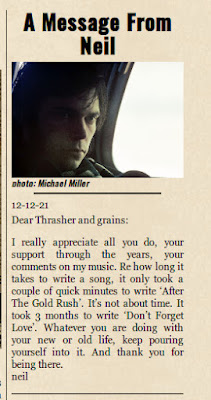


![[EFC Blue Ribbon - Free Speech Online]](http://www.thrasherswheat.org/gifs/free-speech.gif)


 The Unbearable Lightness of Being Neil Young
 Pardon My Heart


 "We're The Ones
  Thanks for Supporting Thrasher's Wheat!


 This blog
 (... he didn't kill himself either...)
#AaronDidntKillHimself
(... he didn't kill himself either...)
#AaronDidntKillHimself






 Neil Young's Moon Songs




 Civic Duty Is Not Terrorism
 Orwell (and Grandpa) Was Right


 What's So Funny About