Decoding Neil: "The Musical Transcendence of Neil Young" by author Martin Halliwell

Here is a rather excellent essay by author Martin Halliwell which explores Neil Young’s long-running fascination with dreams.
From The Musical Transcendence of Neil Young by author Martin Halliwell:
Dreams for Young are sometimes a puzzle to solve and at other times a new geography to explore, corresponding to the two dominant dream theories of the 1960s: the Freudian theory in which dreams are a working through of repressed psychic matter; and the existential humanist view of dreams as an alternative topography.
Dreaming is rarely a doorway to the state of lost innocence for which Young yearns in “Sugar Mountain,” but it has the capacity to transport the singer and the listener elsewhere. Through the act of dreaming Young can drift purposefully, pulling together sounds, images and colours in creative ways, and can explore the twists and turns of the unconscious where one image blurs with the next. The nature of dreams means that their shape keeps morphing. This can lead the dreamer towards deeper meaning, but can also drift away into impressions and noise. At times Young searches for direction–such as the quest on his 2007 track “Spirit Road” to discover the “long highway” within — and at other times escapes from meaning into a play of imagery and sound.
We can identify this second trend in one of Young’s early dream songs, “Broken Arrow.” This six-minute coda to the second Buffalo Springfield album Buffalo Springfield Again seems to be inspired by the early-summer release of The Beatles’ concept album Sgt. Pepper’s Lonely Hearts Club Band, leading Young to incorporate crowd noises from a Beatles concert and the opening distorted snippet of a live performance of “Mr Soul,” sung by drummer Dewey Martin. Despite its musical variety there is little input from the band, except for backing vocals by Richie Furay, added after Young had recorded the song in September 1967. Its power stems from Young’s sound experiments and the visually arresting figure of a Native American standing alone on a riverbank with an empty quiver. This image of the ‘vanishing Indian’ with a broken arrow suggests either surrender to an unstoppable force or an offering of peace.What makes this a mysterious image is that there is no discernible enemy in sight; instead the verses describe a triad of social pressures (fame, adolescence and marriage) as if modern social organization has defeated the nobility of the Native American.
Full excerpt at The Musical Transcendence of Neil Young by author Martin Halliwell.

Also, Martin Halliwell's new book is titled Neil Young: American Traveller (Reverb).
For more on Neil Young's dreams, also see:
- "All Those Dreams" by Neil Young from the album Storytone
- Americana and The American Dream
- Review: Neil Young's Dreamin' Man
- Chrome Dreams II Reviews

‘The Visitor’
by Neil Young + Promise of the Real
"All in a dream, all in a dream
The loading had begun
Flying mother nature's silver seed
To a new home in the sun
Flying mother nature's silver seed
To a new home"
Labels: analysis, book, dreams, lyrics, meaning, neil young, songs
by thrasher@PermaLink: 8/22/2022 04:00:00 PM
5 comments


 >> Pre-Order on Amazon.com <<





 Human Highway


 Concert Review of the Moment


 This Land is My Land

 FREEDOM In A New Year



 *Thanks Neil!*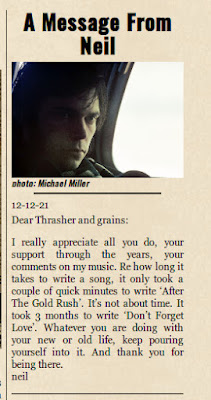


![[EFC Blue Ribbon - Free Speech Online]](http://www.thrasherswheat.org/gifs/free-speech.gif)


 The Unbearable Lightness of Being Neil Young
 Pardon My Heart


 "We're The Ones
  Thanks for Supporting Thrasher's Wheat!


 This blog
 (... he didn't kill himself either...)
#AaronDidntKillHimself
(... he didn't kill himself either...)
#AaronDidntKillHimself







 Neil Young's Moon Songs




 Civic Duty Is Not Terrorism
 Orwell (and Grandpa) Was Right


 What's So Funny About