"Fu##n' Up" Album
Neil & the Horse (Click photo to enlarge)
It would appear that Neil Young has "rebranded" his band Crazy Horse with a new logo and name change.
"The Rider" no longer appears on horse back in the iconic logo. And "Crazy" has been dropped to simply "The Horse".

Neil Young & Crazy Horse
Alchemy Concert Tour - 2012
Which brings us to our Comment of the Moment on Neil Young w/ Crazy Horse 2024 Love Earth Concert Tour by Meta Rocker:
re: the band's name and emblem change.
To my knowledge, we've
been referring to Neil's most important band as "The Horse" for decades
("don't spook the Horse!" "smell the Horse!", etc.), so that alteration
almost didn't register with me.
It does lead to the interesting topic of
NY's music and art in relation to Native American cultures. It seems to
come from a place of genuine interest and even spiritual connection,
but at the same time, Neil's understandings will have been informed by
what he learned in Canadian schools in the 1950s, "cowboys and Indians"
movies, and so on.
In other words, white folks probably have a
different, "outsider's" view of what Native American is and means, as
compared to the lived experiences of First Nations people. It's too easy
for these ideas to turn into pastiches and caricatures, which may get
ingrained as stereotypes. These can be either highly negative or
over-romanticized (think of the "noble savage" trope). In either case,
the result is objectification and othering. It's probably related to the
empiricist tendency to sort everything--and everyone--into discrete
groupings, as opposed to a more holistic worldview, but I'm getting too
deep in the weeds now.
I do think NY is cognizant of these
ambiguities, to some extent.
An eco-protest song titled "Indian Givers"
is fairly self-aware. I remember my grandmother casually using that
expression. It likely became a habit because it made us laugh as very
young children, insofar as we'd never heard it anywhere else: one of
those weird "old people" sayings, where you understand from context what
they mean but it makes so little sense as to seem goofy. I can't
remember her using any other racialized language (does "You're a better
man than I am, Gunga Din!" count?), but it does go to show how these
images and ideas get embedded through cultural transmission.
Thanks for the CotM here Meta Rocker. Your nuanced insights are always welcomed here @ TW. Yet we fear that historical revisionism as gotten completely out of control as the gatekeepers become increasingly desperate while The #BigShift gathers momentum.
All this said however, if we look at the marketing for the 2024 “Love Earth Tour” of Neil Young w/ Crazy Horse, it would seem that the Crazy Horse name is still intact, but the horse is riderless. So the inconsistency remains consistent.
Love Earth TourNeil Young w/ Crazy Horse
So, if we take the "crazy" out of the "The Horse", will there be any spook left?
 "In The Spirit of Crazy Horse"
National Geographic Magazine - August 2012
Back in 2012, we posted on National Geographic Magazine's August 2012 cover of In The Spirit of Crazy Horse. Our hope
was that folks would follow the NG link and go read the wonderful article.
We suggested that maybe modern humans
need to go back and learn from indigenous peoples about how to live
sustainably.
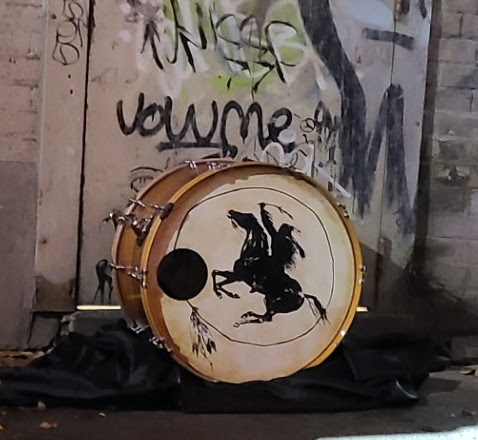
 Crazy Horse*
from album art for Americana by Neil Young & Crazy Horse (2012)
Please note our previous piece Crazy Horse: A Noble American History
and the ensuing uproar. As evidenced by the post, we have nothing but
the utmost respect for Native American history, And for that matter,
indigenous peoples around the world.
From Time to Get Crazy: What We Can Learn from Native American Resistance to Colonists' Greed by Chris Hedges:
There are few resistance figures in American history as noble as Crazy Horse.
He
led, long after he knew that ultimate defeat was inevitable, the most
effective revolt on the plains, wiping out Custer and his men on the
Little BigHorn. “Even the most basic outline of his life shows how great
he was,” Ian Frazier writes in his book “Great Plains,” “because
he remained himself from the moment of his birth to the moment he died;
because he knew exactly where he wanted to live, and never left;
because he may have surrendered, but he was never defeated in battle;
because, although he was killed, even the Army admitted he was never
captured; because he was so free that he didn’t know what a jail looked
like.” His “dislike of the oncoming civilization was
prophetic,” Frazier writes. “He never met the President” and “never rode
on a train, slept in a boarding house, ate at a table.” And “unlike
many people all over the world, when he met white men he was not
diminished by the encounter.”
Crazy Horse was bayoneted to death
on Sept. 5, 1877, after being tricked into walking toward the jail at
Fort Robinson in Nebraska. The moment he understood the trap he pulled
out a knife and fought back. Gen. Phil Sheridan had intended to ship
Crazy Horse to the Dry Tortugas, a group of small islands in the Gulf of
Mexico, where a U.S. Army garrison ran a prison with cells dug out of
the coral. Crazy Horse, even when dying, refused to lie on the white
man’s cot. He insisted on being placed on the floor. Armed soldiers
stood by until he died. And when he breathed his last, Touch the Clouds,
Crazy Horse’s seven-foot-tall Miniconjou friend, pointed to the blanket
that covered the chief’s body and said, “This is the lodge of Crazy
Horse.” His grieving parents buried Crazy Horse in an undisclosed
location. Legend says that his bones turned to rocks and his joints to
flint.
His ferocity of spirit remains a guiding light for all who seek lives of defiance.

Crazy Horse*
Lakota Chief, American-Indian
Long live Crazy Horse! But never Spook The Horse.
 #DontSpookTheHorse
Neil Young & Crazy Horse 2014 Europe Tour
In tribute to Crazy Horse, the "3rd Best Garage Band in the World", here's a look back at some highlights:

Induct Neil Young w/ Crazy Horse
Into the Rock and Roll Hall of Fame
#CrazyHorse4HOF
* see comments below on Crazy Horse image
Labels: @NeilYoungNYA, #CrazyHorse4HOF, #DontSpookTheHorse, #InductTheHorse, #MayTheHorseBeWithYou, #MoreBarn, album, concert, crazy horse, neil young


 Neil YoungInternational Harvesters Tour, Costa Mesa, CA - 10/24/84Photo by Robert Matheu




 >> Pre-Order on Amazon.com <<





 Human Highway


 Concert Review of the Moment


 This Land is My Land

 FREEDOM In A New Year


 *Thanks Neil!*


![[EFC Blue Ribbon - Free Speech Online]](http://www.thrasherswheat.org/gifs/free-speech.gif)


 The Unbearable Lightness of Being Neil Young
 Pardon My Heart


 "We're The Ones
  Thanks for Supporting Thrasher's Wheat!


 This blog
 (... he didn't kill himself either...)
#AaronDidntKillHimself
(... he didn't kill himself either...)
#AaronDidntKillHimself







 Neil Young's Moon Songs




 Civic Duty Is Not Terrorism
 Orwell (and Grandpa) Was Right


 What's So Funny About



Lots of intriguing discussion (both here and elsewhere) about band names, what it means to be “Crazy Horse”, does it matter, etc.
Here’s my perspective:
Let’s imagine a parallel universe where Bob Dylan really was killed in the legendary 1966 motorcycle accident.
(Or, if we want to be less morbid, let’s say he decided to retire from the music biz immediately after.)
The record company decide Bob is worth more to them alive than dead. And so they replace him with another singer/songwriter who strongly resembles him.
He wears a black wig, speaks in the drawl, writes compelling songs….
Nobody notices the difference.
(If this sounds incredible, consider the story of how Andy Warhol once sent an actor to replace himself on a speaking tour. Consider also how, in 2024, AI allows us to convincingly play with what is “real”. And of course, there’s the famous anecdote about Charlie Chaplin once entering a Charlie Chaplin lookalike contest and winning the prize for third place!).
More than 50 years later, this actor is still making Bob Dylan records and touring as a Bob Dylan.
The question is this:
Is he *really* Bob Dylan or not?
My answer is no…
and yes.
No, because it’s clearly not the Bob Dylan who made those classic '60s records for which the original was most famous.
And yes, because it *is* the guy who we’ve accepted as Bob Dylan for the last 5+ decades.
When we think of Bob Dylan, we think of the guy we’ve been listening to for most of our lives. At some point, the name “Bob Dylan” (essentially a brand name) came to stand for the persistent actor, not the fleeting original.
Back to the real world. Is it still Crazy Horse if one of the fundamental members of the group (“the glue… without him, it falls apart” as Niko Bolas once said about Poncho) is missing in action?
YES IT IS. Because clearly, Crazy Horse was around before Poncho Sampedro joined. And if the band can change line-ups once, it can do so again.
And NO, it isn’t. Because the Crazy Horse name is valuable because it stands for something magical — for the unique musical and psychological chemistry that has been nurtured between Neil, Poncho, Ralph and Billy for so many years. To deny that would be to deny the very thing that makes the band special.
If you drop a marshmallow into water, nothing much will happen. If you drop sodium into water, it will explode.
In music, as in chemistry, the specifics *matter*.
But of course, it’s not only sodium that reacts explosively with water. So do other alkali metals.
So the best way to view the 2024 version of Crazy Horse, I think, is as a band that is both separate *and* apart from the classic, longest-running Poncho lineup.
It’s still Crazy Horse, but at the same time, it’s a different Crazy Horse. With at least a partially-different dynamic, and very different chemistry.
Now, will it explode like sodium, or fizzle out? We don’t know until we try.
Seeing the 2024 version of the band as a new Crazy Horse (or at least, a musical cousin of previous versions) isn’t demeaning, but liberating. Because it stops unhelpful comparison with the past.
Listening to the new version of Over and Over, there surely might be the temptation to think “well, it’s pretty good, but obviously it’s not in the same league as earlier versions”. It needs to be heard in the context of 2024, not 1990 or 2012.
(An aside: The story of the new album, as far as one has so far been presented, isn't massively compelling. Perhaps that’s because the fundamentals are inherently less interesting. “Neil Young and Crazy Horse re-tread Ragged Glory at private gig for billionaire” is less compelling than “Neil Young and Crazy Horse play small bar in California and sell tickets at the door.”).
But a 2024 version of, say, Chevrolet? There’s no in-concert precedent to compare that to. So there’s the opportunity to define what it is while it is still growing, still finding its place in the world.
To sum up:
Why is seeing a band like Crazy Horse particularly special? Because the name stands for something. It stands for a very unique musical chemistry that has proved its worthiness on countless albums and countless tours. I don’t think we should gloss over that. And when Neil and Elliot speak in Year of the Horse about how special the relationship is between the four members of the band, they are doing so sincerely.
If these relationships don’t matter, if it’s just a bunch of guys backing Neil Young, then the band name would stand for nothing. To imply it’s the exact same band without Ralph Molina would be ridiculous, and the same applies to Poncho Sampedro — probably the most musically proficient member of the 1976-2013 lineup, as evidenced by his ability to thrive in various non-Crazy-Horse projects with Neil.
So thank you, Poncho Sampedro, for your contributions. You are missed, and the biggest compliment any of us can give is to truthfully say it clearly won’t be the same without you.
At the same time, life goes on. Previous masterpieces (or, more humbly, special moments) have already happened, and their legacy is assured.
But there are still new ones waiting to happen. And that’s both refreshing and inspiring, isn’t it?
Scotsman.