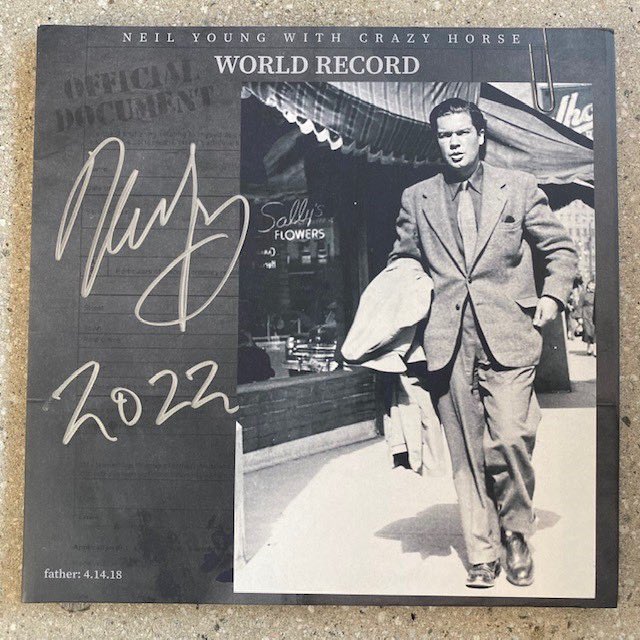
Where to start? The world is a big place… and World Record is a big album.
So let's start with just one song.
Let's start with Chevrolet. Let's take a look under the hood of this song… examine the nuts and bolts and pistons!
And then we'll take it for a ride.
As usual, it's the little details that make all the difference. In Chevrolet, the song's narrator is imagining he's gripping the *ivory* steering wheel. He's *shifting* gears, and *rolling* down the window.
He's *wandering* the highway with that *ancient nomad*.
The Chevrolet's paint is *gleaming*.
Take a second to notice how these personality-filled words (or combinations of words) bring the lyric to life.
"Ivory", for example, might look like a five-letter word. Actually, it's a bundle of creative dynamite!
Neil gives us the key to this song, and we gladly hop in behind the wheel. His passion becomes ours. We can feel the gas-guzzling V8 engine throbbing in front of us.
Guess what? Most folks are saying that Chevrolet is the best song on World Record.
Guess what? I think it is, too. It's a cracker.
Why? Not because it has that reassuring Crazy Horse sound, but because it's one of the songs on World Record that really makes an effort to *connect* with the listener.
(That's what Crazy Horse do. They grab us through the speakers. And it works best when the songwriter shows up with the foundation of *songs* that aim to connect, too.)
Still with me? Now we've dived into the guts of the engine, let's take a broader look at Chevrolet.
In fact, let's do better than that. Let's jump in, right now, and turn the keys in the ignition. How does it feel to take a ride?
The song takes us back to when we were all young and innocent. Back when Neil made Zuma or Ragged Glory or Psychedelic Pill — travelling with David Briggs (or his ghost, perhaps) in a vintage Chevrolet alongside the sun-drenched Malibu beaches.
We're back in the good old days, when a cool car was just a cool car. (Similarly, meat was just a tasty food on our plates... and we may even have made remarks that today would be identifiable as sexist, racist or homophobic.)
The celebratory guitar sound of Chevrolet instantly brings that free-flying nostalgia to mind — and that's no accident.
Back then, we didn't even know about destructive carbon emissions.
(We didn't know about the grisly horrors inside slaughterhouses, either. Even the ones that the organically-farmed animals are sent to).
But now, we do. The switch has been flicked. And we can't unlearn what we now know about the impact our daily decisions have.
It's all about making mistakes when we didn't even know they were mistakes. We regret them, we move on. We grow.
We can still enjoy nostalgia, though — with a bitter-sweet touch of regret!
The best of both worlds.
The sometimes ethereal, sometimes tortured, sometimes near-orgasmic shrieks of noise from Neil's Les Paul guitar (and the vocal harmonies) are the glorious soundtrack to all of this. Amidst the classic Crazy Horse guitar soloing that makes us feel it's 1975 (or 1996 or 2003) all over again.
Whew! And that's just one song. Chevrolet. Complete with predictably-masterful second guitar from Nils Lofgren.
But how about the others?
The other songs are mostly an inside-line to Neil's thoughts. Everything is jotted down... no editing.
The result for the listener as an *outsider*, though, is that the signal intermittently gets lost among the static.
That's always what happens when ideas aren't filtered. Worst case scenario: the wheat and the chaff are mashed together until the wheat is no longer wheat at all!
So when folks write that World Record is "ok", "not bad", "pleasant enough", etc.... What they really mean is that they haven't really been given much to go on. They're outsiders.
They're being invited to peer in through a window into an event that wasn't even created with them in mind.
So it is what it is! I don't think the album as a whole grabs us as vividly as Greendale does, because there's no real engaging narrative — no sustained effort to connect with or reward the listener.
Instead, *you* have to make an effort to get into the songwriter's mindset. Find a dangling thread from the song's lyric, and start climbing it. Then it works.
You do the work, so he doesn't have to.
That's *lyrically*.
*Musically*, it makes every effort to connect. It's one of the punchiest, freshest sounding Neil Young records in recent times.
In particular, it feels like a 10-year layer of dust and grime has been dug out from the inside of the microphones.
And the use (and abuse) of the pump organ, distorto-harmonica and octave-divided electric guitar is as inventive—and as thrilling—as ever.
Crazy Horse is still the best band in the world — and I'll stand on Bruce Springsteen's manager's coffee table and say that. (I'll say it until he lets Nils Lofgren go on tour with Neil... hypothetically, of course!).
But the songs are the foundation. And oftentimes on World Record, it sounds like the songwriter is in two minds.
Does he want to write songs that vividly connect with the listener (even if that listener is himself)? Or does he instead want to *meditate*, where connection is besides the point?
It results in a sort of "neither here nor there" effect which does dampen some (only some) of World Record's formidable gunpowder.
And then we listen to Chevrolet.
And without warning, the songwriter sticks in the knife and jolts us to life.
He turns the key in the ignition. Turns back the years, too.
We're gliding along the sun-drenched highway once again, and the road feels good. *We* feel good. But something more disturbing lurks beneath the surface.
Scotsman.






 >> Pre-Order on Amazon.com <<





 Human Highway


 Concert Review of the Moment


 This Land is My Land

 FREEDOM In A New Year


 *Thanks Neil!*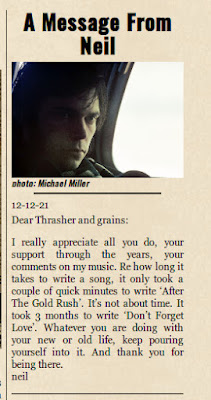


![[EFC Blue Ribbon - Free Speech Online]](http://www.thrasherswheat.org/gifs/free-speech.gif)


 The Unbearable Lightness of Being Neil Young
 Pardon My Heart


 "We're The Ones
  Thanks for Supporting Thrasher's Wheat!


 This blog
 (... he didn't kill himself either...)
#AaronDidntKillHimself
(... he didn't kill himself either...)
#AaronDidntKillHimself







 Neil Young's Moon Songs




 Civic Duty Is Not Terrorism
 Orwell (and Grandpa) Was Right


 What's So Funny About



Thoughts on World Record (unsure where to post at this stage, so they end up here).
After finally having the chance for uninterrupted, close listening, I find Dan's initial take right on. Funnily enough, I last listened to the album while dog-walking, inadvertently mirroring Neil's theme of creating the music while walking. Maybe this is the best way to experience the album, while on the move. Admittedly, this means one doesn't necessarily have access to hi-fi audio equipment while listening. Nonetheless--if FITR is driving music, these are walking songs.
I doubt anyone can add much to scotzman's account of Chevrolet. For me, however, the first nine songs fit together so completely, so organically and symmetrically, as a unit of music that by the time we get to Chevrolet, my most powerful impression of the album has already occurred. Much as Chevrolet is a creature unto itself, side by side by side with the rest of World Record, it feels like icing on the cake, gilding the lily--in the best possible way.
Although the 3LP/2CD configuration is questionable on a couple of levels, my assumption is that Neil (for sound artistic reasons) wanted Chevrolet to stand on its own. That is certainly the effect of putting it on a separate disc, especially when the preceding songs fit together in such an organic way. (One or two indy bands have curated music this way and called it a "double EP", incidentally.)
As usually seems to be the case for me, there are a couple of particularly wonderful songs that others are inclined to overlook. I'm thinking of Overhead and The World (is in Trouble Now). The former is a pure burst of sunny enthusiasm of the soul. The latter, with its shuffling rhythms and bluesy, lurching pump organ, has a different kind of immediacy, an earthy, angsty jumble of impressions that ends up wrestling with existential fears and fundamental questions:
"Because the earth has held me so, I never will let go--I never will let go..." I interpret this as the will to live, the desire to act, even in the face of the inevitable. Songs like this one, Break the Chain, and I Walk with You (Earth Ringtone) deal with liminal spaces between life and death. I Walk with You is the most refined, but The World (is in Trouble Now) is my favorite, perhaps because of its precipitous rawness.
On I Walk with You, for instance, I don't know how anyone can listen to the lumbering, swampy, sawing guitars and not feel the weight of the song. That's without even getting into the words, which should speak for themselves (the mix does occasionally bury vocals but when in doubt, the lyric sheet is your friend).
"Walk with me now to the ends of the earth and you'll see what the damage can be... the end of wars/the price of life/the cost of care/the toll of strife."
The best moments of World Record, like this one, show a mutuality between words and music, where each component makes the most of the other to create a meaningful whole. At the least, I challenge anyone to really pay attention to the words without concluding that some major statements are being made. The primary one being to "love earth and your love comes back to you."
Lastly, despite some comments to the contrary, I don't think it takes special effort to get this experience out of Neil's recent music. At least, no more effort than is required to listen to any music closely, with attention to the whole as well as individual parts.