Neil Young's new release ""World Record" w/ Crazy Horse is now available for pre-order. Order here (Please shop locally & independently. But if you can't, we appreciate your supporting Thrasher's Wheat by clicking this link
or YOUR COUNTRY's FLAG. Thank you!!!) ADVERTISEMENT
An unofficial news blog for Neil Young fans from Thrasher's Wheat with concert and album updates, reviews, analysis, and other Rock & Roll ramblings. Separating the wheat from the chaff since 1996.
Even the most ardent supporters of Sleeps With Angels, the 1994 set from Neil Young and Crazy Horse, admit that it is a bleak album. It likely would have been even without the implication that the title cut was influenced by the suicide of Kurt Cobain.
The song has little to do specifically with him, but more about his generation. The rest of the album has no deep ties to the alt-rock cohort, other than to assure that where it seemed they were going, Young and company had already been. This was their way of saying, “We hoped it would have turned out different for you.”
Here’s another word to consider: “exhaustion.”
What does that mean, exactly? Think back to the 1990s. There was a sense in the air – mostly illusory – of a return to basics, of honesty, stripped-down, and legit. People saw in the music of the day a rejection of the big hair, big eye-makeup, big everything that the culture had wrought. Those bands that merged pop hooks with classic rock and punk’s DIY ethic and simplicity were striking a blow against the hair metal heroes passing out in their million dollar swimming pools, very much in the same way that punk’s first wave struck out against the coke-fueled hedonism of disco and the acid-tinged wandering of progressive rock. It seemed that, once again, the voices of youth and dissenters could be heard. Even if the “message” frequently was complete gobbledygook, as a lot of the era’s lyrics were (Pearl Jam’s “Yellow Ledbetter” is an example of a sound looking for a statement, failing, and going for it anyway), this was a declaration of being.
Full review of the “Sleeps With Angels” album and videos of Neil Young and Crazy Horse on Music Tap by Dw Dunphy.
Cobain's use of the lyrics had a profound impact on Young, who recorded portions of the 1994 'Sleeps With Angels' album in Cobain's memory.
Apparently, Neil Young had been trying to reach Cobain by telephone in the days before his suicide to no avail.
From New Musical Express article "Reflective Glory" (07/15/95) by Steve Sutherland & Kevin Cummins on recording "Mirror Ball" (Neil Young and Pearl Jam collaboration) in the aftermath of Nirvana's Kurt Cobain's suicide and the contradictory forces of life and death:
On "Mirror Ball", though, the natural incompatibility of these forces has been raised into shocking relief by one disciple choosing an unfeasibly extreme interpretation of Young's message when Kurt Cobain quoted, "It's Better to burn out, than to fade away." In his suicide note, citing Young's lyric as artistic justification for ending his inconsolable anguish, Young was shaken to the bone. Always an advocate of allowing the listener his or her own individual path through a record, he was so devastated by Cobain's personal reaction to a song that was basically written as a celebration of Punk that he was impelled to record the 'Sleeps With Angels' album in lament."
The NME article continues and observes:
"Perversely, it is testament to Young's emotive power that Cobain should choose his words as an epitaph, but it is something Young still visibly shudders from. Once a song is out there on the radio, he reasons, it's not anyone's responsibility anymore.
'It's the machine and the fuel. It's over now. I'm not behind the wheel at all. It's gone. It's over.'
As for Cobain, he mutters: 'I don't wanna talk about that. I just don't know what to say. Obviously his interpretation should not be taken to mean there's only two ways to go and one of them is death.'
He laughs a cold, dry laugh.
It's rumoured that Young was trying to contact Cobain at the time of his suicide, that he somehow foresaw the tragedy coming.
'I don't wanna talk about it," says Young. 'I really don't because I respect the fact that he's a guy who did what he did and, y'know, he did what he had to do and I don't wanna get any ...' He falters and recomposes himself behind alarming blue shades.
'I prefer to not be involved at all. I certainly don't wanna take advantage of talking about something like that for the interest of somebody else I've never met and selling myself in paper in the process. I'd rather you just left it out. It's just distasteful to me.' "
During Neil Young's induction speech into the Rock & Roll Hall of Fame on January 13, 1995, Young choked up and concluded by thanking Cobain for "all of the inspiration".
It has been debated as to whether Kurt Cobain or Neil Young is the Godfather of Grunge? Cobain's demise has only added to Nirvana's musical legacy and influence. Yet Young has strenuously avoided any such labeling, preferring to be called "Don Grungio" instead.
From a Neil Young interview in MOJO Magazine with Nick Kent:
Q. Sleeps With Angels seems deeply haunted by the spectre of Kurt Cobain and his sad end...
A. Sleeps With Angels has a lot of overtones to it, from different situations that were described in it. A lot of sad scenes (pause), I've never really spoken about why I made that album. I don't want to start now.
Q. Has it anything to do with the similarity of Kurt Cobain's death to Crazy Horse Danny Whitten's death in 1972? They both looked so much alike...
A. I just don't want to talk about that. That's my decision. I've made a choice not to talk about it and I'm sticking to it. [Also see, Danny Whitten and Kurt Cobain: Tragic Similarities]
Q. Let's not discuss Cobain's death then. But what about his life? Did his music inspire you?
A. He really, really inspired me. He was so great. Wonderful. One of the best, but more than that. Kurt was one of the absolute best of all time for me.
Q. "Scenery" on Mirror Ball (recorded with Pearl Jam) seems equally haunted by Cobain's doomed image. It's like there's OJ Simpson on one side and Kurt Cobain on the other: two very different victims of celebrity madness?
A. Well, the problems with celebrity and rock'n'roll start with the fact that nowadays it gets way too big too fast. Back in the '50s and '60s, rock'n'roll was 'big' but it was only 'big' to people who cared about it.
Now it's big to people who don't care about it. So they can't begin to understand it. They just make ill-informed judgements on performers without first comprehending why or what it was that made the person famous in the first place. In the '60s there was a bond between the artists and the audience.
It's harder to see now because so much these days is simply down to image projection. But today's pessimistic bands have a vision and an attitude that's unified their generation just like the 'peace and love' groups helped unify the '60s generation.


 >> Pre-Order on Amazon.com <<





 Human Highway


 Concert Review of the Moment


 This Land is My Land

 FREEDOM In A New Year



 *Thanks Neil!*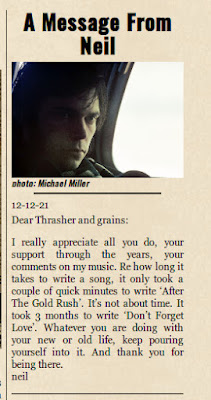


![[EFC Blue Ribbon - Free Speech Online]](http://www.thrasherswheat.org/gifs/free-speech.gif)


 The Unbearable Lightness of Being Neil Young
 Pardon My Heart


 "We're The Ones
  Thanks for Supporting Thrasher's Wheat!


 This blog
 (... he didn't kill himself either...)
#AaronDidntKillHimself
(... he didn't kill himself either...)
#AaronDidntKillHimself







 Neil Young's Moon Songs




 Civic Duty Is Not Terrorism
 Orwell (and Grandpa) Was Right


 What's So Funny About